VII. Will the Proportion of Good Air Quality Days Drop Sharply with the Implementation of Stricter National Standards?
The revised
Ambient Air Quality Standards officially took effect on March 1, 2026, with the upper threshold for the "good" daily air quality tier tightened accordingly. The new standards will be implemented in two phases: the transition period spans 2026 to 2030, during which the annual PM2.5 limit is set at 30 μg/m³ and the daily limit at 60 μg/m³; starting in 2031, stricter limits of 25 μg/m³ (annual) and 50 μg/m³ (daily) will be fully enforced. Upon full implementation, the Grade II PM2.5 limits will be generally aligned with the interim target-2 specified in the WHO Global Air Quality Guidelines.
Since the release of its 6th assessment report in 2019, the research team has consistently called for alignment with international benchmarks. This standard revision represents a positive response to appeals from numerous researchers including the team itself.
Will compliance rates plunge under the tighter standards? The report carried out simulations based on 2025 monitoring data. Calculated against the daily transition-period standard, the average proportion of days with good and excellent air quality across the 177 cities stands at 89.7%. When applying the 2031 formal standard, the figure remains 83.8% — 5 percentage points higher than the 78.8% recorded in 2016 under the former, more lenient standards.
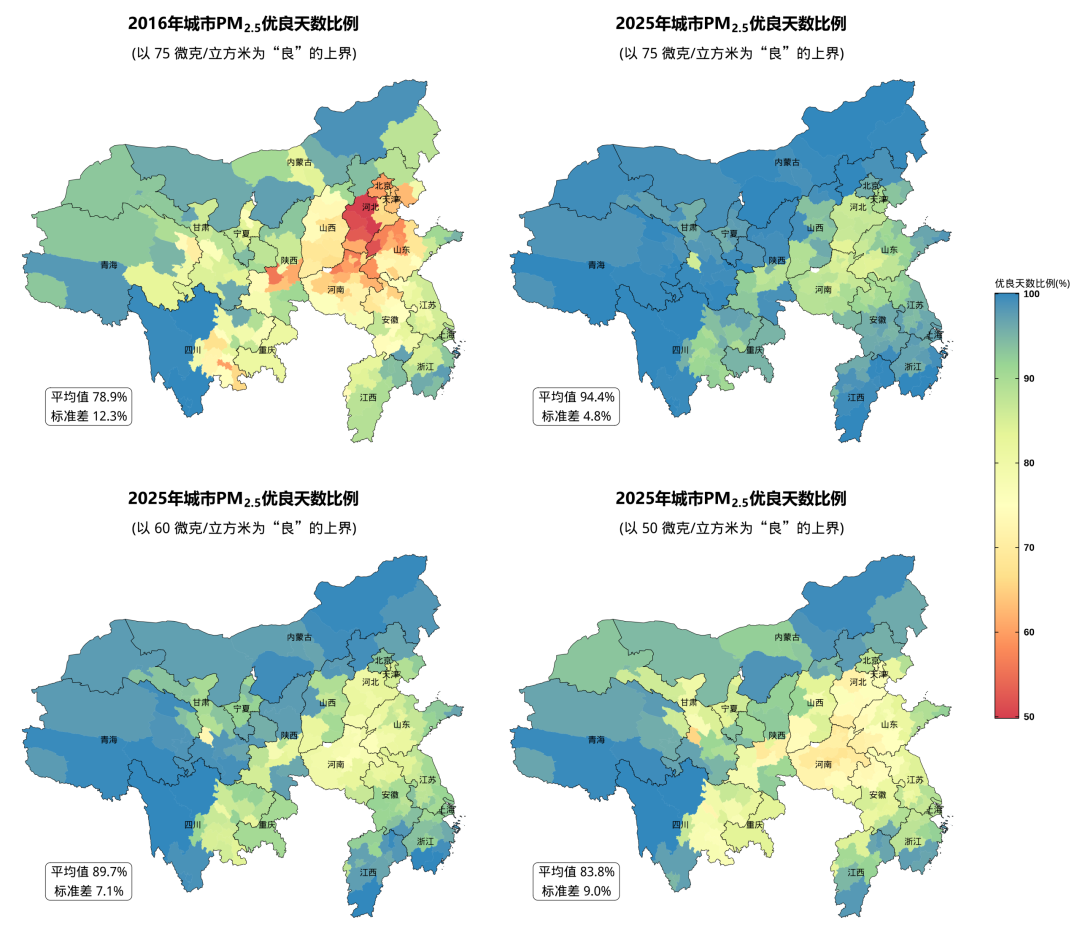
Map showing the proportion of days with good and excellent PM2.5 air quality across the "4 municipalities plus 173 cities"
This leads to two key conclusions. First, a decade of pollution control efforts has created a buffer to accommodate the new stricter standards, meaning the compliance pressure will not be as severe as anticipated. Second, the tightened standards will widen the performance gap between cities: they provide an incentive for cities already meeting targets to pursue further improvements, while pushing non-compliant cities to scale up governance actions.
Nevertheless, against the 2031 official standards, around 60 percent of cities nationwide still record annual average PM2.5 concentrations above 25 μg/m³, according to data from the Ministry of Ecology and Environment. The revised national standards mark not an endpoint, but a starting line for the next phase of air pollution control. There remains ample room for further progress.

