I. Newly Added Provincial Assessment Coverage: Gansu and Qinghai Included in the Monitoring Scope
Building on the "4 municipalities plus 151 cities" framework adopted in the previous report, this edition incorporates 14 prefecture-level cities (prefectures) in Gansu Province and 8 prefecture-level cities (prefectures) in Qinghai Province, adding a total of 22 cities. With this expansion, the research scope covers 177 prefecture-level and above cities nationwide, encompassing 1,053 national air quality monitoring stations that serve approximately 59.4% of China’s total population.
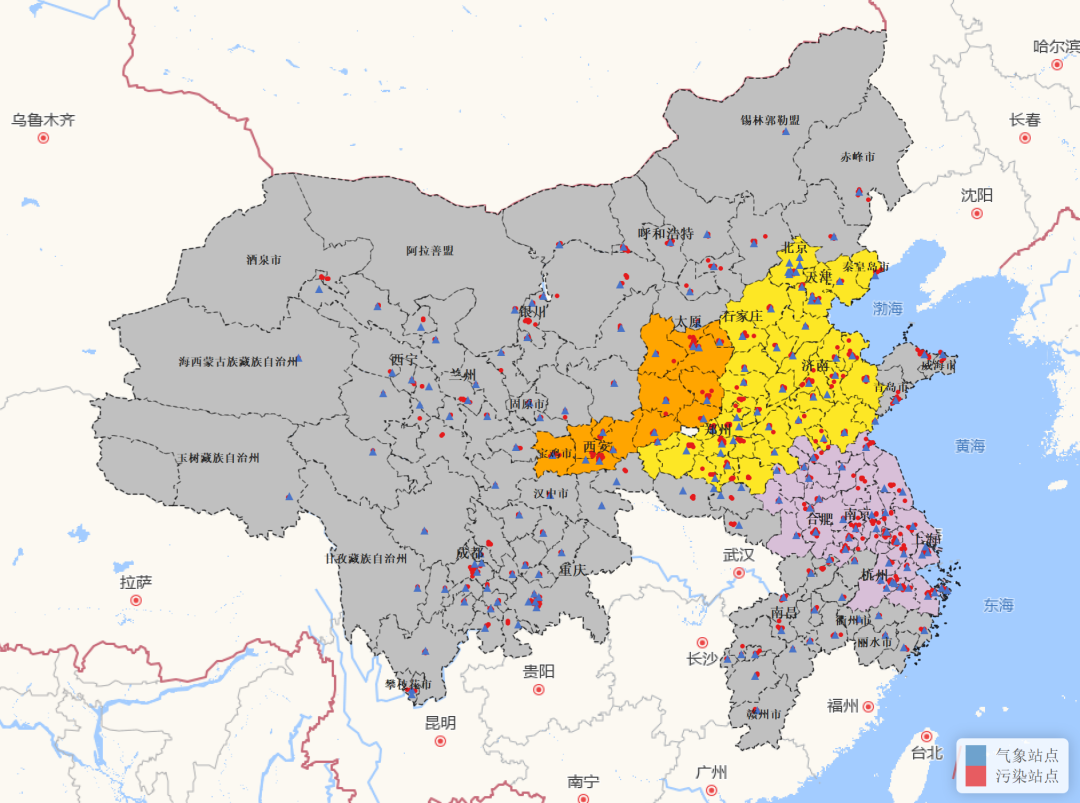
• Stands for pollution monitoring stations
△ Stands for meteorological stations
(The yellow shaded area in the figure covers the "2+36" cities in the Beijing-Tianjin-Hebei and surrounding regions; the orange shaded area represents the 13 cities on the Fenwei Plain; the purple shaded area denotes the Yangtze River Delta region; the gray shaded area refers to "other cities")
Prior academic research on air quality in Northwest China has mostly focused on major cities such as Lanzhou and Xining or typical pollution episodes. Systematic long-term assessments covering all prefecture-level cities with meteorological and dust signal adjustments remain relatively scarce. By incorporating Gansu and Qinghai Provinces into long-term tracking, this report helps fully depict the regional heterogeneity of atmospheric pollution across China.
Preliminary evaluation results reveal distinct pollution profiles in the newly included cities compared with central and eastern regions. In 2025, cities including Jiuquan, Zhangye and Linxia in Gansu posted some of the highest annual average PM10 concentrations among the 177 cities monitored, highlighting severe coarse particulate matter pollution. Xining, Haidong and other areas in Qinghai recorded relatively high carbon monoxide levels. Meanwhile, particulate pollution rebounded in parts of both provinces in 2025: annual average PM2.5 and PM10 concentrations in Gansu rose by 9.5% and 16.1% year-on-year respectively, while PM10 concentrations also climbed in Qinghai. These newly covered cities provide critical samples for understanding pollution formation mechanisms and governance demands in western China, and signal that differentiated regional policies should be prioritized in the next phase of air quality management.

