V. Ozone’s Turnaround in 2025 During the 14th Five-Year Plan: Will This Improvement Be Sustained?
Ozone stands out as the most distinctive among the six monitored pollutants. During the 13th Five-Year Plan period, while the other five pollutants saw continuous declines, spring and summer ozone concentrations rose by a cumulative 15.4%, making it the only pollutant with an upward trend. This growth momentum was initially curbed in the 14th Five-Year Plan period, with overall ozone levels flat against 2020 benchmarks, a result driven almost entirely by the dramatic reversal observed in 2025.
From 2022 to 2024, spring and summer ozone concentrations rebounded across most provinces from their temporary lows recorded in 2020–2021, with the exception of Jiangsu, Zhejiang, Shanghai, Jiangxi and Shaanxi. The ozone pollution challenge became increasingly prominent amid steady PM2.5 improvements. A turning point arrived in 2025: spring and summer ozone concentrations saw the first widespread improvement since 2021, falling by 7% in summer and 10.1% in autumn year-on-year, with notable reductions achieved in 122 cities. Provinces including Shandong, Shanxi, Hebei and Shaanxi registered their lowest ozone levels since 2017.
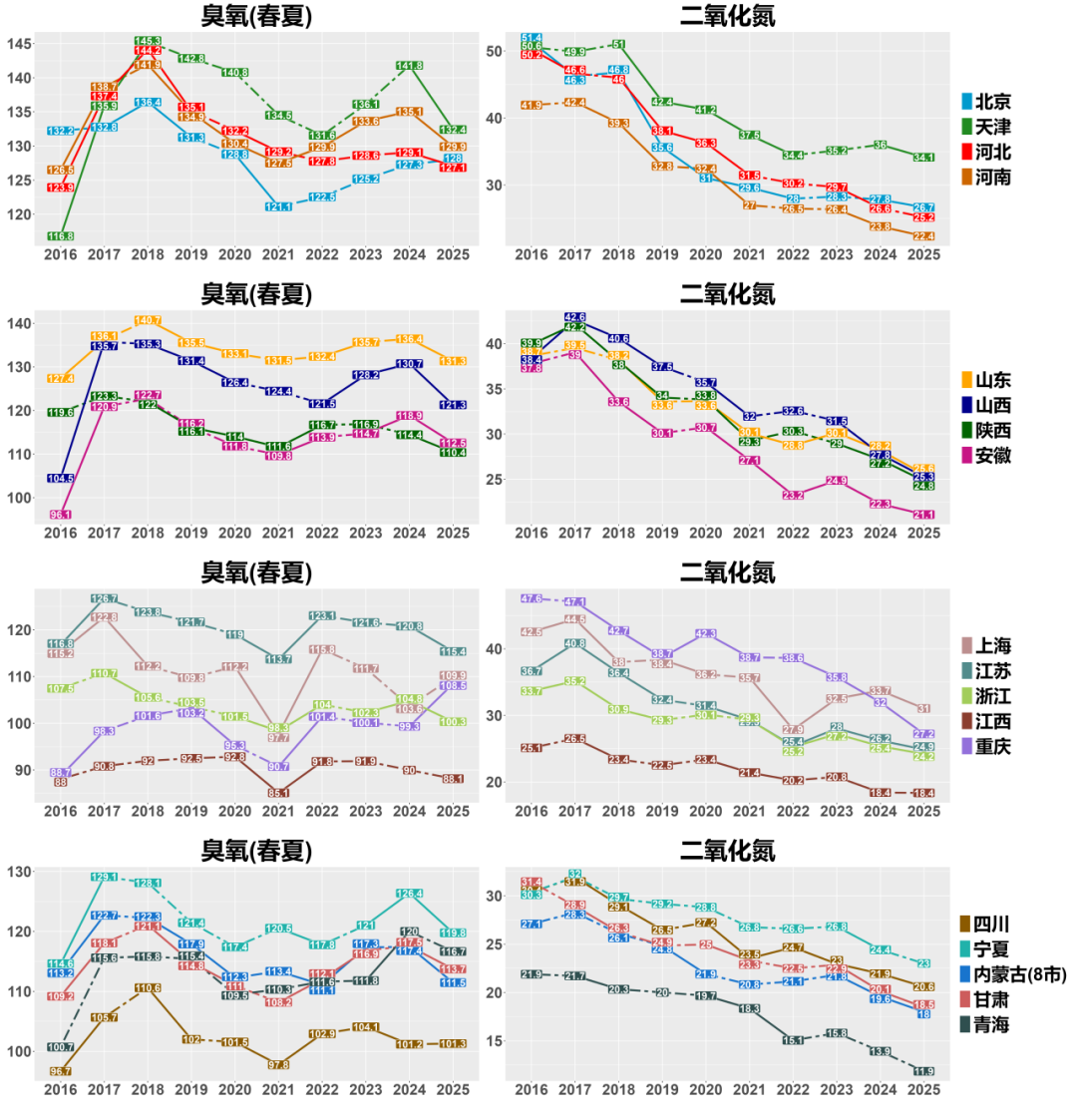
Time series of meteorology-adjusted 8-hour O₃ (spring-summer) and NO₂ annual average concentrations (μg/m³) from 2016 to 2025 across the "4 municipalities plus 173 cities"
The report cautiously notes that the sustainability of this improvement remains to be verified in subsequent years. Ozone concentrations in most provinces are still higher than the lows recorded during the pandemic prevention and control period. Levels in Chongqing and Shanghai rose by more than 10% compared with 2021, while Beijing has seen a continuous upward trend since 2021, with its 2025 ozone concentration exceeding the average of Hebei Province. Ozone pollution in megacities has yet to be alleviated.
A noteworthy shift is underway in the seasonal pattern of ozone pollution. The gap between spring and summer ozone concentrations across the 177 cities narrowed from 15 μg/m³ in the previous year to 5 μg/m³ in 2025. Approximately one-third of cities registered spring ozone levels comparable to or even higher than summer readings. Spring ozone pollution was particularly severe in the Jiangsu-Zhejiang-Shanghai-Anhui region and Jiangxi Province, where spring concentrations climbed markedly in 39 cities, with an average year-on-year increase of 8.9%. Ozone pollution is evolving from a "summer-only issue" to a year-round challenge prominent in both spring and summer.
The report also identifies a weakening synergistic correlation between nitrogen dioxide — a critical ozone precursor — and ozone concentrations. From 2017 to 2021, concentrations of both pollutants declined synchronously nationwide. After 2022, NO₂ levels kept falling steadily, while ozone experienced periodic rebounds. In 2025, regions witnessing ozone rebounds including Chongqing, Shanghai and Beijing all recorded substantial year-on-year drops in NO₂ concentrations. This indicates that NOₓ emission reductions alone can no longer sustainably drive down ozone levels; ozone formation is increasingly governed by VOCs limitations or joint NOₓ-VOCs coordinated control strategies. The governance progress achieved in 2025 offers valuable experience for ozone pollution prevention and control, yet its long-term durability requires continued observation, calling for in-depth summary of relevant regulatory measures.

