VI. Extreme Pollution: Hidden Health Hazards Behind Compliance Rates
Annual average pollutant concentrations and the proportion of days with good air quality are the two most widely recognized indicators by the public, yet they fail to fully reflect acute health risks. The report adopts the 90th percentile concentration in the most polluted season each year — a value corresponding to pollution levels observed on at least 9 to 10 high-pollution days annually — to capture days with severe pollution events that pose hidden health threats.
In 2025, merely 61 out of the 177 cities met the standard for the annual 90th percentile ozone concentration, covering 18.2% of the national population; only 29 cities achieved compliance for the annual 90th percentile PM2.5 concentration, accounting for just 8.9% of the population. Over 90% of the population lives in cities where extreme PM2.5 pollution levels still exceed the transitional standard limits.
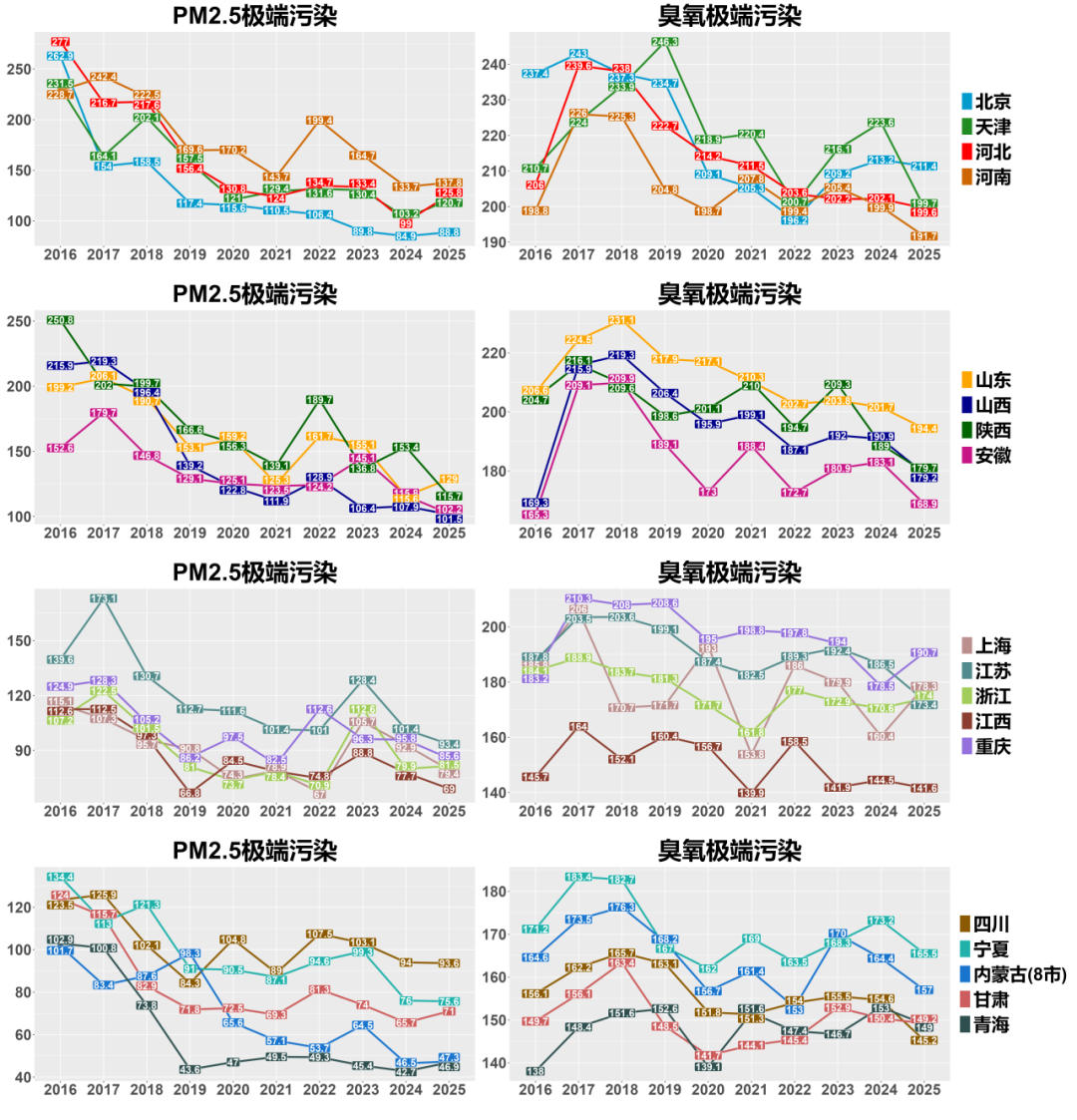
Time series of meteorology-adjusted annual 90th percentile concentrations (μg/m³) of PM2.5 and 8‑hour maximum O₃ across the "4 municipalities plus 173 cities", 2016–2025
A noteworthy detail is that only 42% of cities that met the annual average PM2.5 standard also satisfied the daily concentration criteria simultaneously. In other words, residents in some nominally compliant cities may still be hit by unexpected episodes of extreme pollution.
From a seasonal perspective, extreme PM2.5 pollution rebounded in autumn, with concentrations rising year-on-year in 100 cities and nine more cities exceeding standards compared with the previous year. Springtime extreme ozone pollution also trended upward. Regions with extreme high levels of both pollutants largely overlapped, around two-thirds concentrated in the Beijing-Tianjin-Hebei surrounding area, prominently Shandong, Hebei and Henan. Notably, Huaibei, a city within the Yangtze River Delta, recorded persistently dual high extremes of PM2.5 and ozone for two consecutive years (2024–2025).
The report argues that as pollution control deepens, seasonal targeted management alone can no longer cope with the seasonal redistribution of pollution risks. It proposes an extension toward precise daily-scale risk prevention and control. On the basis of sustained elimination of severe pollution episodes, authorities should further reduce population exposure levels to extreme pollution.

