III. Latecomer Advantage? Nitrogen Dioxide Takes the Lead This Time
During the 14th Five-Year Plan period, nitrogen dioxide posted an average urban reduction rate of 25.3%, surpassing sulfur dioxide, which had led pollution abatement progress in the 13th Five-Year Plan period, to become the pollutant with the most prominent improvement. This marked a notable shift in the priority structure of pollution mitigation.
In the 13th Five-Year Plan period, emission cuts from coal-fired sources served as the core driving force, delivering a cumulative 57% drop in sulfur dioxide concentrations. By the 14th Five-Year Plan period, ultra-low emission retrofits for coal-fired power plants were largely completed, leaving limited room for further sulfur dioxide reductions, whose decline slowed to 24.6%. Meanwhile, the reduction rate of nitrogen dioxide jumped from 11.5% in the 13th Five-Year Plan to 25.3%, reflecting tangible emission cuts from mobile sources and industrial combustion sources. Region-wide, nitrogen dioxide concentrations declined across all provinces and municipalities, demonstrating the policy guidance of the Action Plan for Sustained Improvement of Air Quality on nitrogen oxide abatement.
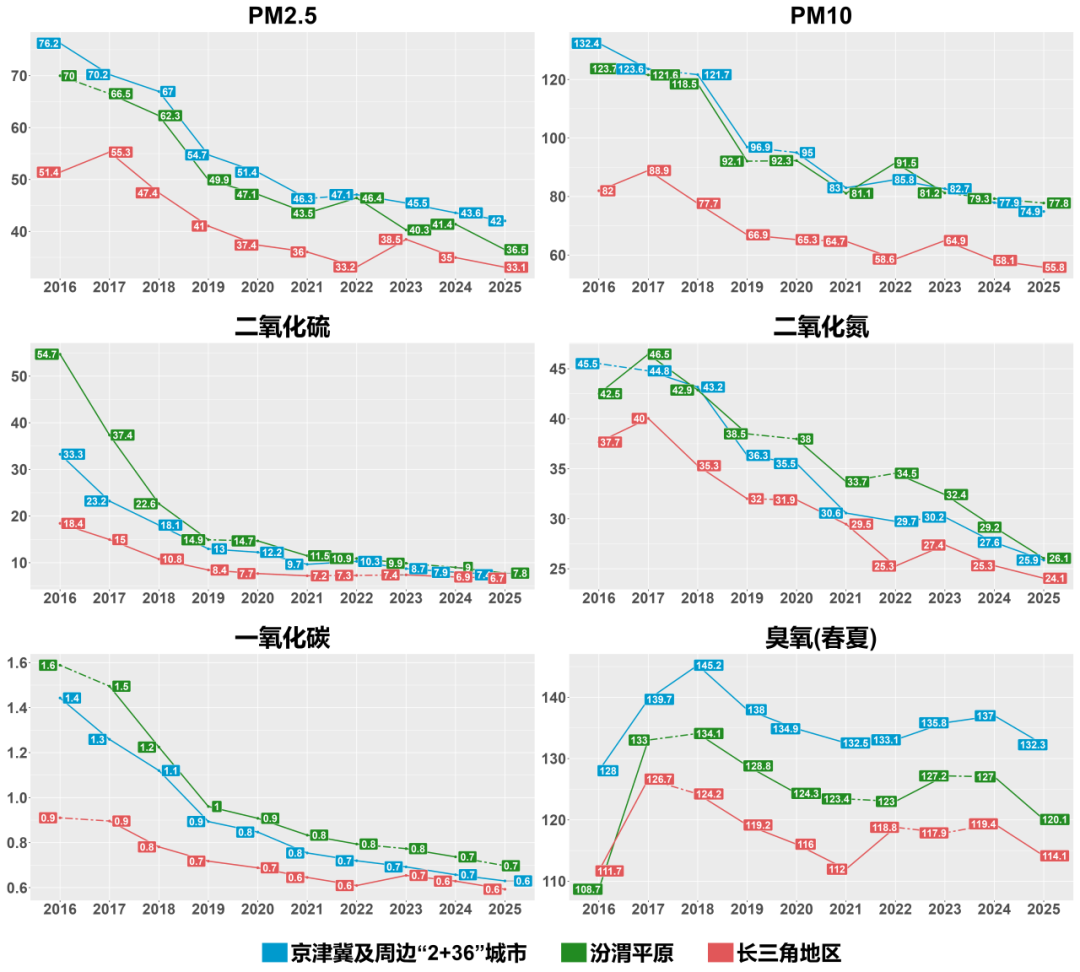
Time series plots of annual average concentrations of six air pollutants from 2016 to 2025 for the "2+36" cities in the Beijing-Tianjin-Hebei surrounding region, the Fenwei Plain, and the Yangtze River Delta
Compared with the 13th Five-Year Plan period, the reduction rates of PM2.5 and PM10 have narrowed, reflecting rising marginal governance difficulty as air pollution control enters a deep-water phase. Meanwhile, the report identifies disparities in pollution abatement progress across regions: the reduction magnitudes of certain pollutants in Beijing-Tianjin, Sichuan-Chongqing, Jiangsu and Zhejiang fall behind those of similar neighboring provinces. Northwest regions including Gansu, Ningxia and Qinghai face setbacks such as PM10 rebound and unsatisfactory PM2.5 mitigation effects.

