2024–2025, the research group led by Professor Lijian Yang achieved a series of important advances in applied probability, time series, and functional data analysis. Selected results are summarized as follows.
Result 1. The research team of Lijian Yang investigated the exact quantiles of the extreme value distribution of Gaussian processes, addressing the long-standing fundamental issues of existence and (partially) uniqueness. These results provide essential probabilistic foundations for a wide range of Gaussian-process-based statistical inference procedures.
(Yang 2024; Yang 2025; Yang 2025; Statistics & Probability Letters)
Result 2. PhD student Yinghuai Yi introduced the concept of a mildly varying trend, which differs from the commonly used slowly varying trend. Using kernel and spline estimators, the authors constructed asymptotic simultaneous confidence bands for the mildly varying trend function of ARMA time series over expanding intervals, and established the implicit efficiency of the maximum likelihood estimators of the ARMA coefficients.
(Yi, Song and Yang 2025, Journal of Nonparametric Statistics)
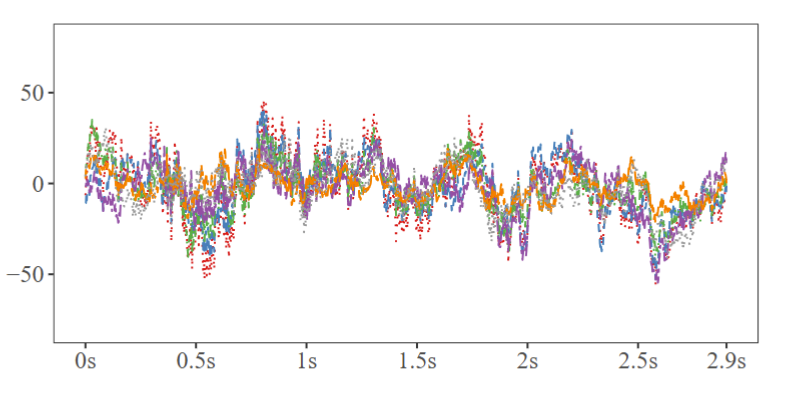
Result 3. PhD student Shuang Sun developed implicitly efficient spline estimators for the mean function of multivariate functional panel data, and constructed several types of simultaneous confidence regions for the mean function, with applications to EEG data analysis.
(Sun and Yang 2025, Statistica Sinica)
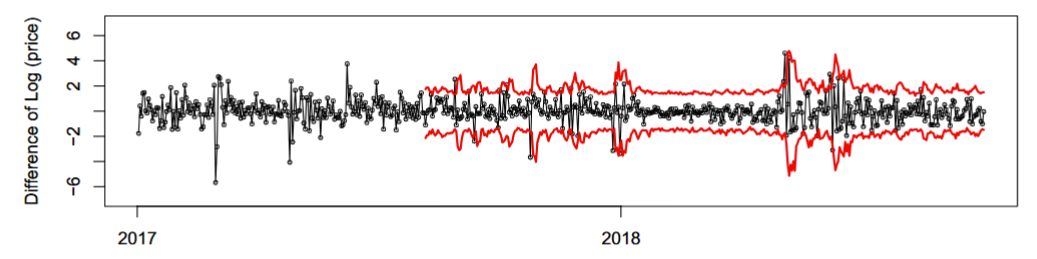
Result 4. Dr. Chen Zhong, a graduate of the group, employed kernel estimators of probability distribution functions to construct consistent multi-step prediction intervals for autoregressive conditional heteroscedastic (ARCH) time series. The work also established asymptotic simultaneous confidence bands for the innovation distribution function and proposed a test for symmetry.
(Zhong, Zhang and Yang 2025, TEST)
Result 5. PhD student Qirui Hu applied spline regression to address change-point detection for the variance function of functional data and constructed confidence intervals for the change point. This working paper, completed under the supervision of Lijian Yang, received the 2024 IMS Hannan Graduate Student Travel Award from the Institute of Mathematical Statistics. In joint work with Dr. Jie Li, a graduate of the group, triangulation-based implicitly efficient bivariate spline estimators were developed for the mean function of longitudinal image data on irregular domains, together with simultaneous confidence regions for the mean function. The related invention patent, “Simultaneous Confidence Surface Acquisition for Spatial Regions and Its System,” has been granted by the China National Intellectual Property Administration.
(Hu 2024, Journal of Multivariate Analysis; Hu and Li 2024, Statistica Sinica; Hu and Yang 2026+, Statistica Sinica)

Result 6. PhD student Leheng Cai and Qirui Hu addressed several fundamental inference problems in functional data analysis. They constructed confidence intervals for eigenvalues and simultaneous confidence bands for eigenfunctions, and developed simultaneous inference procedures for eigen-systems with a diverging number of components. These results were further extended to image data defined on irregular domains. They also constructed simultaneous confidence bands for distribution functions of unobservable functional principal components, and developed simultaneous inference methods for mean functions of functional data ranging from sparse to dense sampling designs.
(Cai and Hu 2024, Computational Statistics & Data Analysis; Cai and Hu 2025, Journal of Computational & Graphical Statistics; Cai and Hu 2026, Statistica Sinica; Cai and Hu 2025, Statistics and Computing)
Result 7. PhD student Yongzhen Feng, with collaborators, proposed a new nonparametric test for conditional independence between a scalar response and a functional covariate across continuous quantile levels. The method constructs a test statistic based on random projections of functional covariates, establishes its asymptotic properties under both the null and alternative hypotheses, and applies a multiplier bootstrap procedure for fast critical value computation. The method was applied to EEG data analysis.
(Feng, Li and Song 2024, Biometrics)
Result 8. PhD student Sijie Zheng and Dr. Kun Huang proposed statistical inference tools for covariance functions of functional data with dependent errors.
(Zheng, Huang and Yang 2025, Electronic Journal of Statistics)

