Jun Liu, Member of the U.S. National Academy of Sciences, Xinghua Distinguished Chair Professor at Tsinghua University, and Department Head of the Department of Statistics and Data Science, was invited by the Chemical Industry and Engineering Society of China and Science China to give a live-streamed informal talk on "Statistics and Artificial Intelligence." The content was released across multiple platforms, including People's Daily, Guangming Online, Yangshipin, and the China Youth Daily app. The talk began with personal choices, statistical intuition, and the AI wave, aiming to make social science outreach more accessible and help more people understand: the hotter AI gets, the more important statistics becomes.
Overview
Professor Jun Liu began by reflecting on his own academic choices. Statistics appealed to him for several reasons: it confronts uncertainty head-on, it intersects with a wide range of disciplines, and at the time it was not yet fully systematized, offering ample room for improvement. His mentors' habit of reasoning from first principles and their willingness to venture into unfamiliar territory also influenced his later move into areas such as bioinformatics and genetic statistics. He particularly noted that when choosing a major, one need not fixate only on what is popular—interest is often what sustains a person over the long run.
In his view, statistics is the methodology for collecting data, analyzing data, and drawing conclusions from data. High-quality data is crucial to both statistics and AI training.
Professor Liu also cited the failure of Google Flu Trends, which mistook confounding factors such as winter weather and sporting events for genuine influenza signals; only after seasonality and confounding were removed did its accuracy improve. These examples all point to the same thing: data does not speak for itself. Statistical thinking enables us to discern the biases and uncertainties concealed within data, and to understand AI hallucinations—many of which originate in the data and the manner of training.
To Professor Liu, the relationship between statistics and AI can be summed up in two sentences: statistics is "from data to wisdom," whereas AI is more like "from wisdom to data." AI takes statistical methods as its engine and data as its fuel. Machine learning can be traced back to Gaussian linear regression, and later evolved into deep networks, generative models, diffusion models, embeddings, Transformers, and reinforcement learning. Embeddings map words, images, and semantics into vector space; Transformers enhance contextual associations; and reinforcement learning learns strategies through interaction with the environment and reward-and-penalty signals. Diffusion models add noise step by step, then reverse the process to denoise and generate images—a process that fundamentally involves stochastic differential equations, probability, and statistics. In other words, to truly understand AI, mathematics, probability, and statistics are the underlying language one cannot avoid.
Finally, he discussed how AI translates into real-world application. When large models are applied directly to fields such as healthcare, the life sciences, materials design, digital humanities, earth and environmental science, and digital governance, they often fall just short of the "last mile" in terms of precision. Bridging that gap requires statistical models to connect domain expertise, data relationships, and uncertainty quantification. He therefore concluded that statistical data science is the key that unlocks AI's real-world impact. Going forward, we should take statistical thinking as our foundation, interdisciplinary innovation as our pathway, and methodological confidence as our driving force, in order to develop and define a new kind of artificial intelligence.
Professor Liu also introduced Tsinghua University's Master of Applied Statistics (Part-Time) professional degree program, whose objective is to adopt a practice-oriented approach and to develop data science talent with strong core competitiveness.
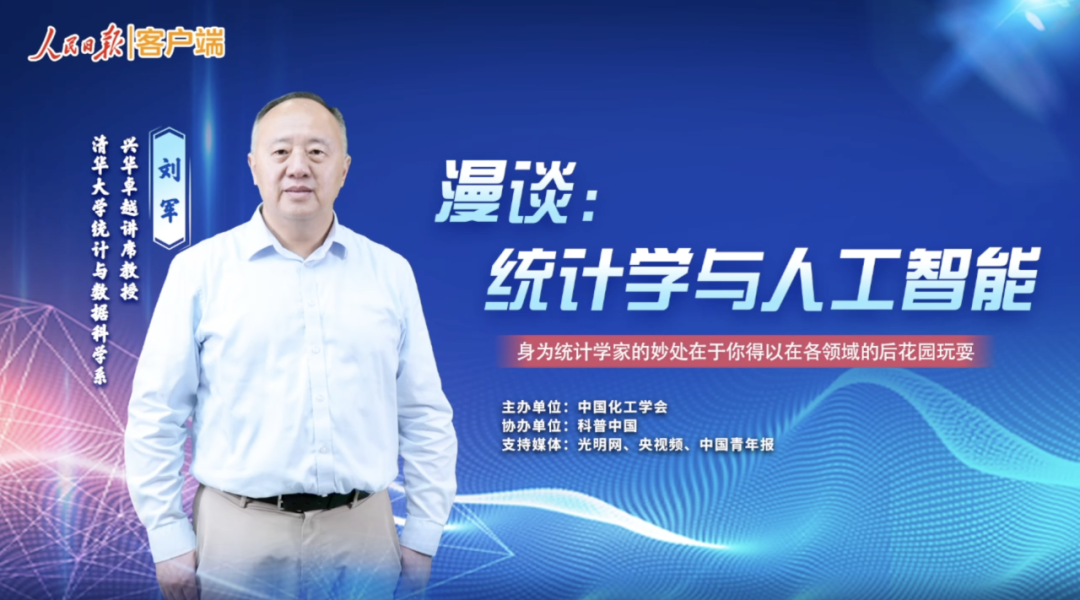
Click the image to watch the vedio

