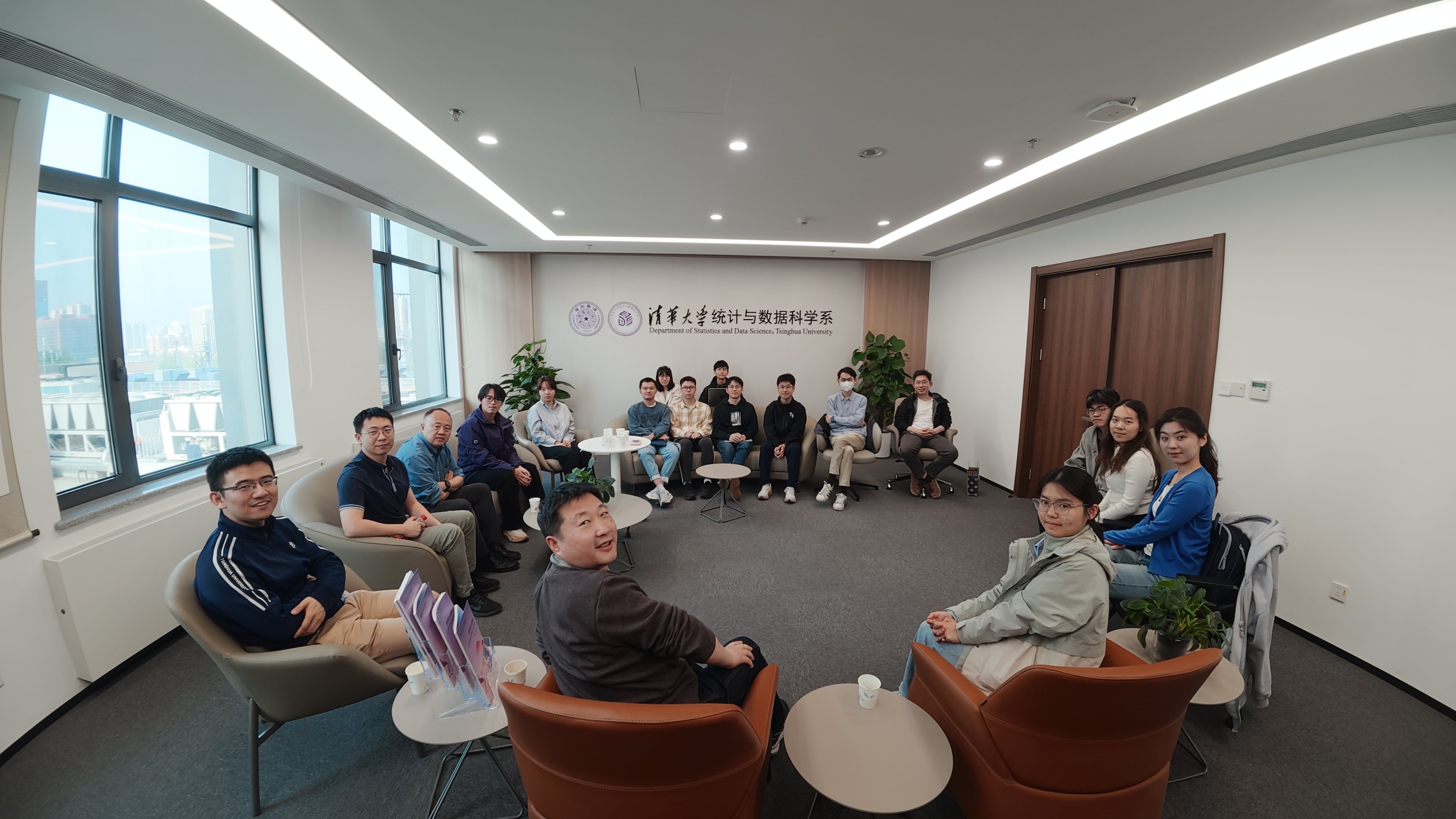
On April 17, 2026, the Department of Statistics and Data Science at Tsinghua University hosted its first-ever 'Department Head's Afternoon Tea' gathering at the Lyu Dalong Building. Department Head,member of the U.S. National Academy of Sciences Jun Liu led nearly two hours of intensive dialogue and open exchange with participating faculty and students, focusing on topics including the intersection of statistics and artificial intelligence ('Statistics × AI'). The event was marked by a warm and engaging atmosphere; students posed a flurry of questions, all of which were met with Professor Liu's thorough responses.
Statistics & AI:
Symbiosis and Irreplaceable Decision-Making Edge
Professor Liu began by elaborating on the fundamental role of statistics in the age of artificial intelligence. He noted that the foundational logic of AI is, at its core, the engineering realization of probabilistic and statistical thinking. A robust statistical grounding is essential for gaining a genuine understanding of how AI functions.
He emphasized that statistics offers more than just algorithms—it provides a scientific framework for making decisions. Take classification problems, for example. When a model returns similar scores for several categories, statistics can provide theoretical assurance to help decide whether to go ahead with a classification or to hold back and ask for more evidence. This ability to measure uncertainty and control risk is exactly where statistics can make a real difference in the age of large models.
Professor Liu also pointed out that AI is a powerful tool, but statistics is the thinking that guides how to use it. Statisticians should be actively applying AI to solve real problems, rather than just chasing bigger models. There's a lot statistics can do in areas like model reliability, uncertainty quantification, dimensionality reduction, and feature extraction. At the same time, classic statistical challenges—like quantile regression—can be tackled in fresh ways using AI techniques such as Diffusion models and Transformers, giving us "new answers to old questions."
Strengthen the Fundamentals of Mathematics from an Early Stage and Embrace Interdisciplinary Convergence
When it came to talent development, Professor Liu stressed how important it is to build a solid mathematical foundation from an early stage. He explained that rigorous mathematical training in subjects like calculus and probability isn't just about learning formulas—it's about shaping how you think. Understanding concepts like uncertainty and confidence intervals, for example, is essential for for future research and innovation.
Professor Liu also walked us through the highlights of the department's undergraduate curriculum. Core courses are offered earlier on, so students can build a strong math and stats foundation right away. At the same time, they're encouraged to take classes in computer science and other related fields to fill any gaps in hands-on engineering skills. He believes that statistics graduates have great career prospects—whether in industry or academia—and that the real key is learning to combine statistical thinking with specific areas like finance, biology, or sociology, which gives them a unique edge.
Academic Evaluation and Frontier Trends: Upholding Rigor, Resisting 'Fast-Paced' Fads
Professor Liu also addressed the growing pressure to publish quickly in today's academic world. He encouraged students to stay calm and focused, noting that fast-paced output often brings a lot of noise along with it. Statisticians, he said, should stay true to scientific rigor and not get caught up in chasing numbers. "A good idea will be valuable anywhere," he added.
Professor Liu also shared his thoughts on where large models are headed. He suggested that the current Scaling Law might just be an observed pattern, not the true essence of intelligence, and that simply throwing more compute at the problem isn't a sustainable answer. The real opportunity, he said, could lie in figuring out how to extract the key features from large models—similar to what sufficient statistics do—to reduce dimensionality from pixel-level information to abstract concept. And that, he pointed out, is exactly what statistics has always been good at.
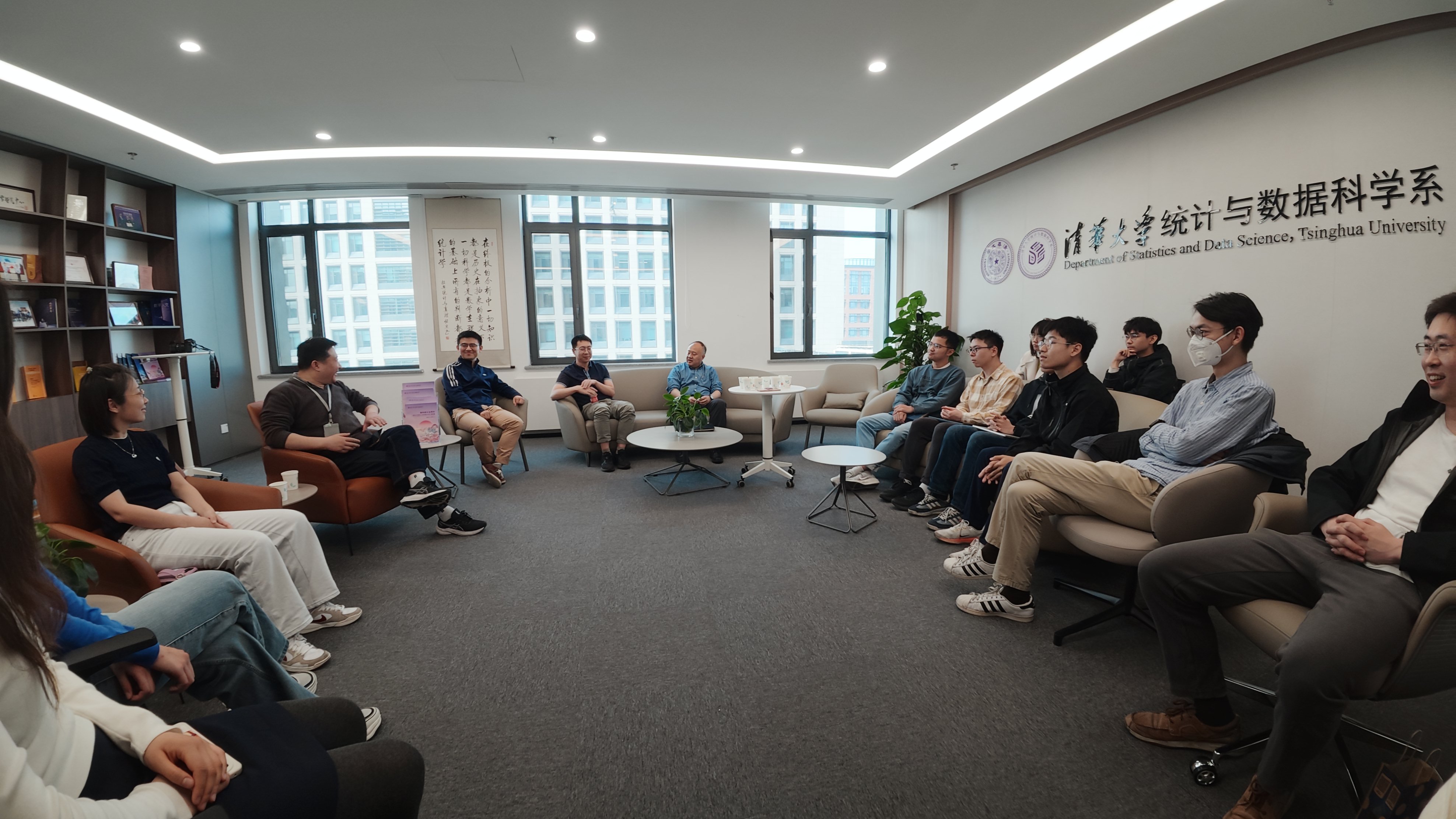
In the open Q&A, students raised questions on topics like "the statistician's role in the AI era" and "coping with publication anxiety." Professor Liu addressed each one, reaffirming the department's mission: build a strong foundation in math and statistics, strengthen computing and engineering skills, and leverage statistical thinking to guide the application of AI to real-world problems.

